
Hunter Hague
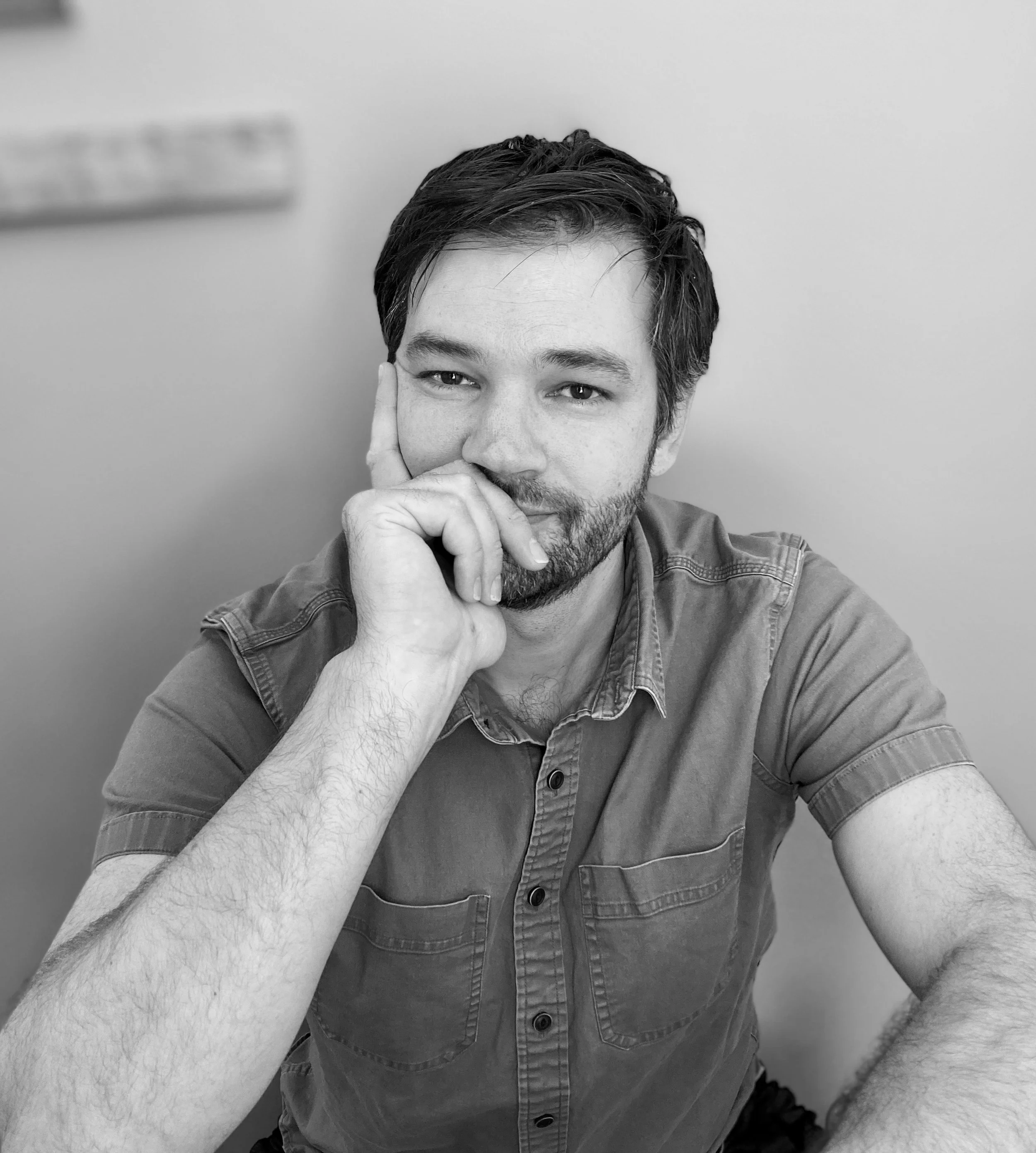
ORP: What inspired you to begin writing or creating? Has that source of inspiration changed throughout your life?
Hunter Hague: My brother and I somewhat frequently spent the night in my parents' room when we were kids. It was a sleeping-bags-on-floor situation. At some point, my parents put down a small carpet to make the floor softer. One night I must have been causing a nuisance because my brother rolled me up in the carpet and left me there. I was in a tube or cocoon made of carpet. I stayed in that cocoon tube for a long time, and it was there--on my parents' floor, brother sleeping beside me--I thought about an idea for an action movie that would star Sylvester Stallone. Perhaps the first story I recall writing. Of course it's not hard to figure out how I came up with this genre: long before I read for fun, I watched Sylvester Stallone and Arnold Schwarzenegger action movies with my dad and brother. But why the spontaneous creation in the cocoon tube? I don't know. I feel like this impulse has maybe always been there. And over the years when I've felt like quitting (due to people not liking my stories, boo hoo, poor me), I knew I could never actually quit, because this desire to write is part of me.
ORP: Do you write or create with an audience in mind? If so, how do you consider the relationship between that audience and your work throughout your creative process?
HH: I like this question a lot. I've been slow (in my writing journey) to respect the audience and their expectations. You sometimes hear writing advice along the lines of: 'be true to yourself.' I don't think that's wrong, but young writers who don't know anything can sometimes take advice too literally. Like me. I thought if I wrote stories that were unique, creative, strange and felt like 'my kind of thing,' felt 'true to me,' then I would be all set. It turns out not in my case. (I once wrote a 60,000 word novel from the perspective of a male reproductive unit. My writing friends politely informed me not to expect any letters from Sweden.) In his craft book A Swim in the Pond in the Rain, George Saunders describes a story as a series of expectations/ resolution moments. This is an interesting (audience-centric) way of looking at the structure of a story, which has helped me pull my writing closer into alignment with what the general reader can tolerate.
ORP: What would you say is your most interesting writing and/or artistic quirk? Do you have any habits that you believe help or hinder your creativity?
HH: Before having kids, my daily writing time seemed limitless. I could sit down and work on a story for hours before my job, hours after returning home, hours in the evening. This was great except with all that time I fell prey to overthinking my stories. When I became a father, the huge blurry potential of my free time snapped into focus. I now have about seventy-five minutes a day to practice my craft (4:45 to 6:00 AM). Paradoxically, this restriction has come with two benefits. 1). Because it’s so short and rigid, I rearrange things in my life so I’m always there. I never miss the writing window. 2). Once I’m done writing at around 6:00 AM, I basically ‘clock out.’ I make lunch for daycare, get ready for work, and prepare myself to field a hundred questions from my toddler (“Are we on that road or this road? Why a motorcycle?”). There’s no time to dwell on plot issues or self-doubt! To be fair, I would write more if I could, but I think my creative practice has benefitted from childrearing. (It’s also an ancient and miraculous undertaking, but we were just talking practically here.)
ORP: What books have you read many times?
HH: Arthur Miller’s 1949 play Death of a Salesman has spoken more powerfully to my heart than almost any other fictional creation I’ve read or seen. With its mythic language ("A man is not a bird to come and go with the springtime," and "The jungle is dark, but full of diamonds,”) and its devastating structure, it gets me every time. After the curtain came down on the Broadway debut of Death of a Salesman, a soon-to-be-famous audience member remembered that, “the doctor had to be called because [fathers] couldn’t stop crying.” (This according to a New York Times review of the Wendell Pierce production a few years ago. The observer of all these tears was the director Mike Nichols.) A fantastic quote! How could it possibly be true? Even still, it represents the play's very real power. Indeed, Willy Loman's tragic struggle does reduce grown men to weeping. I should know.
