
You're Also Eligible
Eneida P. Alcalde
An interview with Thammika Songkaeo on reimagining and reclaiming environmental writing
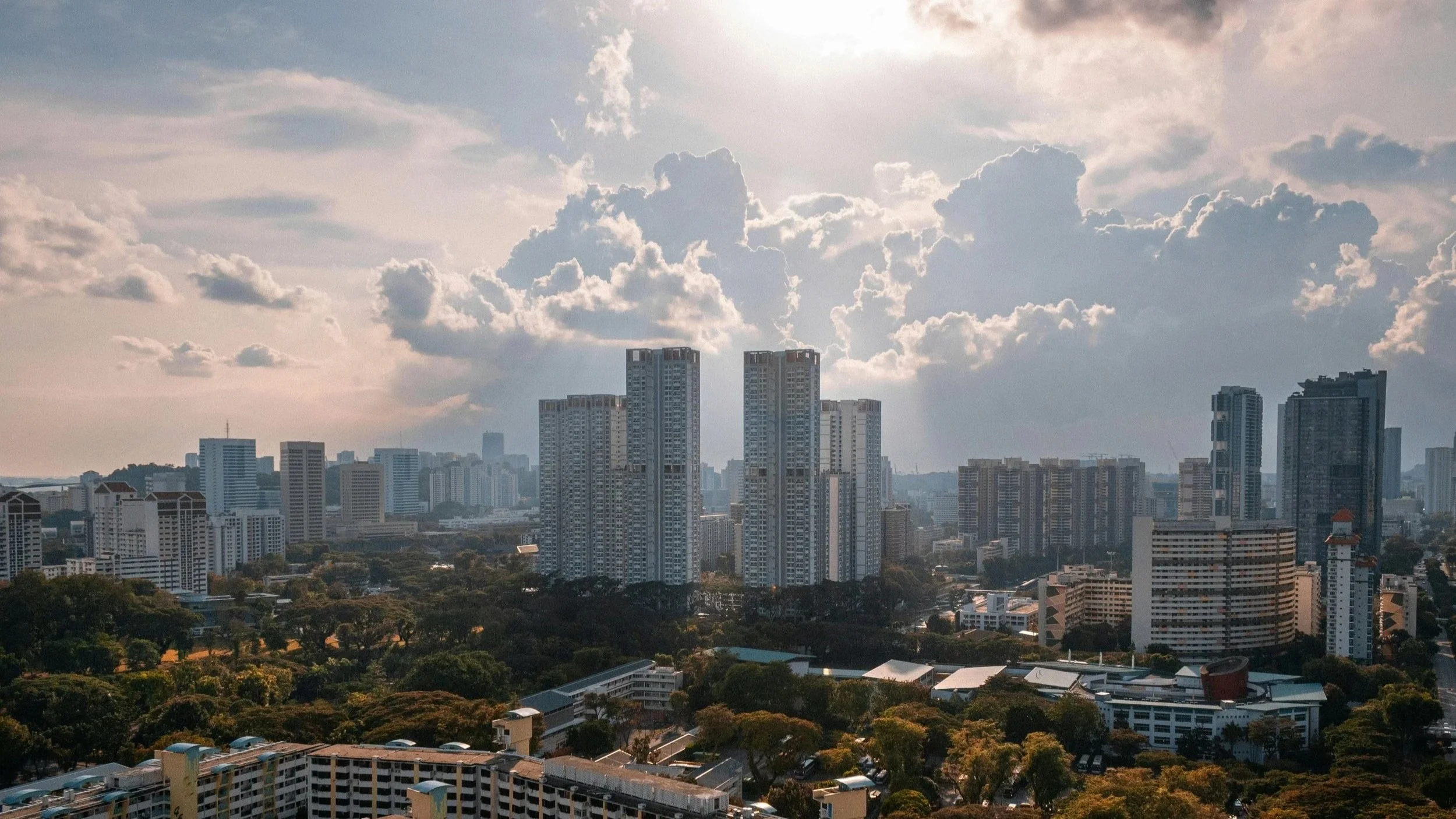
View of Singapore’s urban landscape featuring high-rise residential housing under daylight. Photo courtesy of Sam Tan.
Environmental writing has long been understood through familiar, striking imagery: remote untouched landscapes, fragile ecosystems under threat, dense mythic forests, and vast mysterious oceans written about by solitary writers seeking to gain a deeper understanding of nature and our place within it. Yet for many, our closest encounter with “nature” may be the nearby neighborhood park or community garden, as our lives unfold amidst condo towers and office buildings, subways and bus routes, surveillance systems, and the artificial lights peppering the concrete layers of modern cities. According to the United Nations, 68% of the world’s population is projected to live in urban areas by 2050, adding an estimated 2.5 billion people to urban populations worldwide. As urbanization continues to spread, this phenomenon raises the question: What happens when traditional environmental writing becomes increasingly inaccessible to so many of us?
For National Geographic Explorer and author of Stamford Hospital, Thammika Songkaeo, this question sits at the center of her literary work and her upcoming ORP Schools course, You’re Also Eligible: Reimagining the Environmental Writer. The two-part course interrogates the mental barriers many of us face when writing stories about “the environment” from our seemingly ordinary homes and urban realities. Challenging the assumption that environmental writing must follow a remote template, Songkaeo—whose literary work explores the psychological and structural dimensions of urban life—encourages us to reconsider who gets to write about the environment in the first place, while drawing attention to the environments that have historically been excluded from the genre altogether.
In the interview that follows, Songkaeo discusses our rapidly urbanizing world, the complex emotional architecture of cities, and why environmental writing belongs just as much to the person living beside a mall in a high-rise apartment building as it does to someone documenting remote wilderness and wildlife.

Portrait of Thammika Songkaeo. Photo courtesy of Natthawut Taeja.
Environmental writing belongs to anyone who wants to write about their lived environment
Eneida P. Alcalde: Could you introduce yourself, including your name, creative work, place of residence, and what you mean when you say You’re Also Eligible?
Thammika Songkaeo: My name’s Thammika Songkaeo, and I am based in Singapore, where many would doubt the relevance of environmental writers because of the urbanity, but I suggest that environmental writers can and should exist anywhere—because what is an updated definition of “environment”? As urban environments continue to grow, only relatively few people will have access to pristine natural environments—and they will likely be the privileged few who can buy or maintain access to those places. In my narrative, “environmental writing” belongs to anyone who wants to write about their lived environment; they make changing environments both relevant and central to their work. I’m a National Geographic Explorer whose stories tell the struggles of humans in the urban environment.
EPA: Your novel Stamford Hospital is set in Singapore, a city-state often perceived as hyper-urban and modern. Yet, the environment in your book feels alive and more complex. How did you approach writing an urban setting as an active force rather than a decorative backdrop?
TS: My stories assume environments are characters—and, realistically and neurologically, they already are for all of us: every human responds to their environment. The environment around us makes demands on what we need to live (money? a built home?), while also providing options (jobs? schools?) for us to choose from.
In my book, I approached writing an urban setting by seeing what that setting did to the protagonist’s choices—where did the environment liberate or trap her?
EPA: The protagonist, Tarisa, has an intimate interior experience that I found visceral as a reader. Her sense of entrapment in marriage, motherhood, and identity feels palpable. How did you navigate the relationship between her inner emotional landscape and her external physical environment?
TS: Many people think about “connectivity” when they think about urban environments, but the visceral experience readers undergo while inhabiting Tarisa’s mind comes from the opposite: disconnect.
Her emotional landscape is parched—while so much goes on around her. In this book, I compartmentalized the individual human mind against the collective mind of her immediate society.
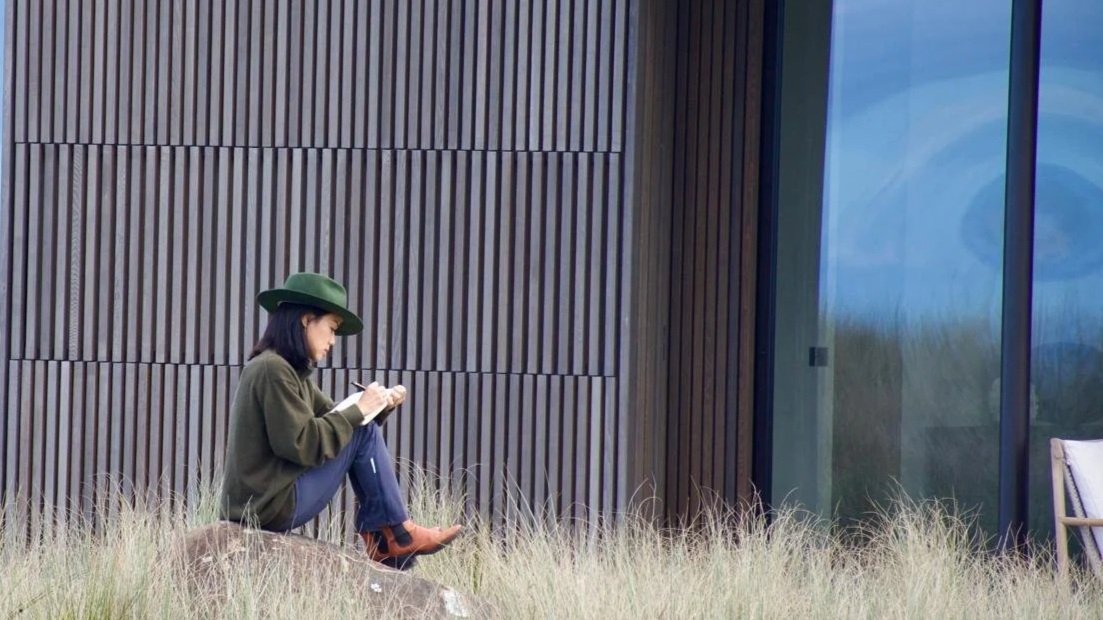
Thammika at work amid the environment. Photo courtesy of Thammika Songkaeo.
EPA: Many of us have read stories of animals in the wilderness, adventures in remote places, or investigative reports on the worsening climate crisis. What I love about your book—and the course you’ll be offering through ORP Schools—is that it challenges these assumptions. In your view, what feels limiting about the traditional sense of an environmental writer?
TS: To write stories about animals in the wilderness, adventures in remote places, or investigative reports—at least the ones that make rounds globally—many writers have to come from a place of mobility privilege. Those who can cover these stories have powerful passports, access to finances, and a race and/or a gender that doesn’t get them stopped or harassed—and if they’re not writing in English, they have to somehow have a translator (which means either domestic translation infrastructure or access to funding for an international translation opportunity). From the start, many writers who fit the image of the environmental writer as the common imagination understands it, do not self-censor from embarking on the trip in the first place—because they don’t have to.
This is problematic because it quietly builds restricted access into the genre.
Adding to this the idea that many environments in degradation are not degraded by choice from the locals but are environments degraded by commercial interests of outside parties few locals feel they can control, we have to ask ourselves what will happen to “environmental writing” if people aren’t even in control of their environments? Do we let “environmental writing” stay what it is in the common imagination—i.e. odes to pristine oceans and mountains—or do we do more work to highlight that everyone has the right to participate in environmental writing simply because they live in that environment, whatever it may be? I think the latter is much more reflective of the truths of this world.
Environmental writing is a way of making the unseen more visible and felt
EPA: The title of your course, You’re Also Eligible, feels both welcoming and provocative. It makes me wonder: Who has historically been excluded from environmental writing and what does it mean to expand that definition?
TS: For one, I think most urban dwellers have been excluded. Secondly, due to the logistics I mentioned above, I think someone from, say, a “weak” passport nation with restricted international mobility, or someone in a body that typically becomes targeted for harassment, would historically be excluded. (And when there is self-censorship, it shouldn’t be seen as their fault, since they’re trying to protect their safety.) Expanding that definition means we recognize that more people can write from where they feel safe, connected, and know they have something to say about the world.
The environment is the world, including the changing world. Having something to say about the city, for instance, doesn’t mean someone doesn’t know how to write about the environment. It means someone knows how to consider this—in its beauty and its ugliness—as the environment—and those shades of thinking are what we want to see reflected as the world urbanizes.
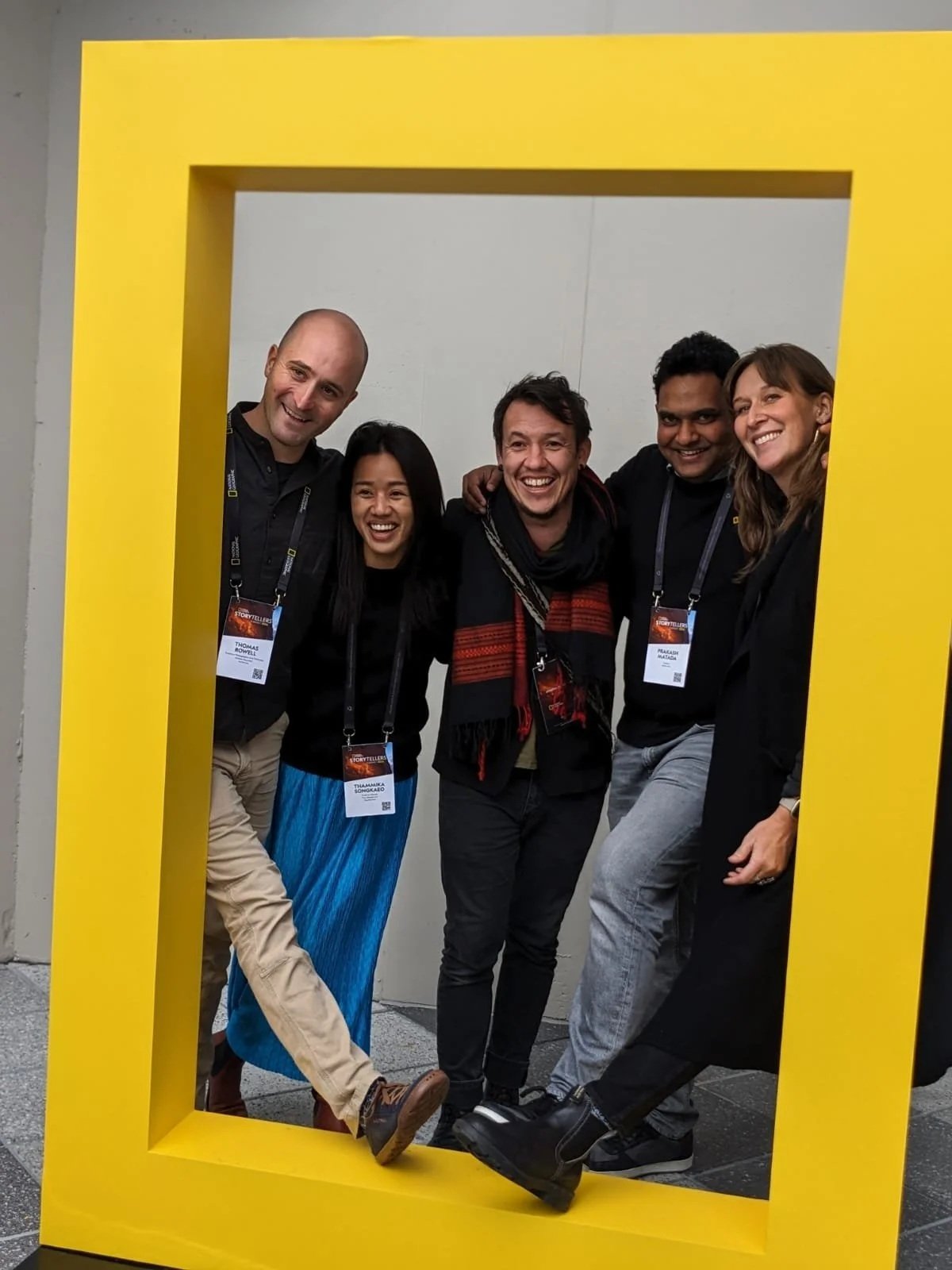
Thammika Songkaeo with fellow National Geographic Explorers, pictured within the iconic National Geographic gold frame. Photo courtesy of Thammika Songkaeo.
EPA: According to National Geographic, National Geographic Explorers are extraordinary individuals in their fields—they see the difference between the world as it is and as it could be. How did this experience inform or complicate the intimate environmental lens we find in Stamford Hospital?
TS: That is so lovely to see that’s how NatGeo sees us! (I did not know that.) Being someone who sees “the difference between the world as it is and as it could be” subconsciously informed Stamford Hospital in many ways—I think that’s why some have seen it as “the story of a mind”. While many books are plot-driven, Stamford Hospital isn’t. It’s a character-driven book that’s essentially about the volatility and disturbances of having perspectives that can’t be externalized.
EPA: I read your book in two sittings—a feat for a busy parent of a young child. It engrossed me, I think, in large part because of the constant tension between visibility and invisibility: what is seen in Tarisa’s world versus what remains hidden. Do you see environmental writing as a way of making the unseen more visible and felt?
TS: Yes—I think there are at least two things that matter for environmental writing: recognizing the environment and recognizing how that perception of the environment impacts both the individual and society. The environment is external (“visible”), but our relationship with it is what makes it internal (“invisible”). Environmental writing is a way of making the unseen more visible and felt because, by engaging in environmental writing, we let ourselves and others see what’s going on in our minds, with the things we project onto the external environment.
EPA: Singapore is clean, efficient, and even utopian by many standards. What drew you to explore the underside of this narrative?
TS: Singapore is the way that it is (which is splendid in many ways) because its leaders decided what costs it would take to achieve those results. Many of the costs were—and still are—human. To be human in a space whose costs were human is interesting. You get many things humans want to get in terms of infrastructure, but you also have to live with the many ways efficiency strips power away from people. I was interested in exploring this: What happens when power is stripped away from a person who was so ambitious? I hadn’t seen many narratives on this.
EPA: In your course, how do you guide writers to locate “the environment” in their lives?
TS: The environment begins with what your five senses give you as reality.
The environment is not necessarily greenery (though it can be).
The environment is what you are given to take in.
EPA: Having grown up in different places, including a small town where the most exciting activity as a kid was visiting a strip mall, I feel that many people see their lives as too ordinary, too small or too urban, and too removed from the wilderness depicted in traditional environmental stories. What would you say to them?
TS: Who made it that way? What industries, for instance? What came before you that you didn’t have control over? How would you use writing to respond to them now, to let them know what you really think about the world they made possible for you?
What power do you have—starting with feeling, thinking, writing—that would make it possible for you, and others, to feel your individual and communal strength to make things better? Strength doesn’t always have to mean “combative” either. It can sometimes mean a soft presence, too.
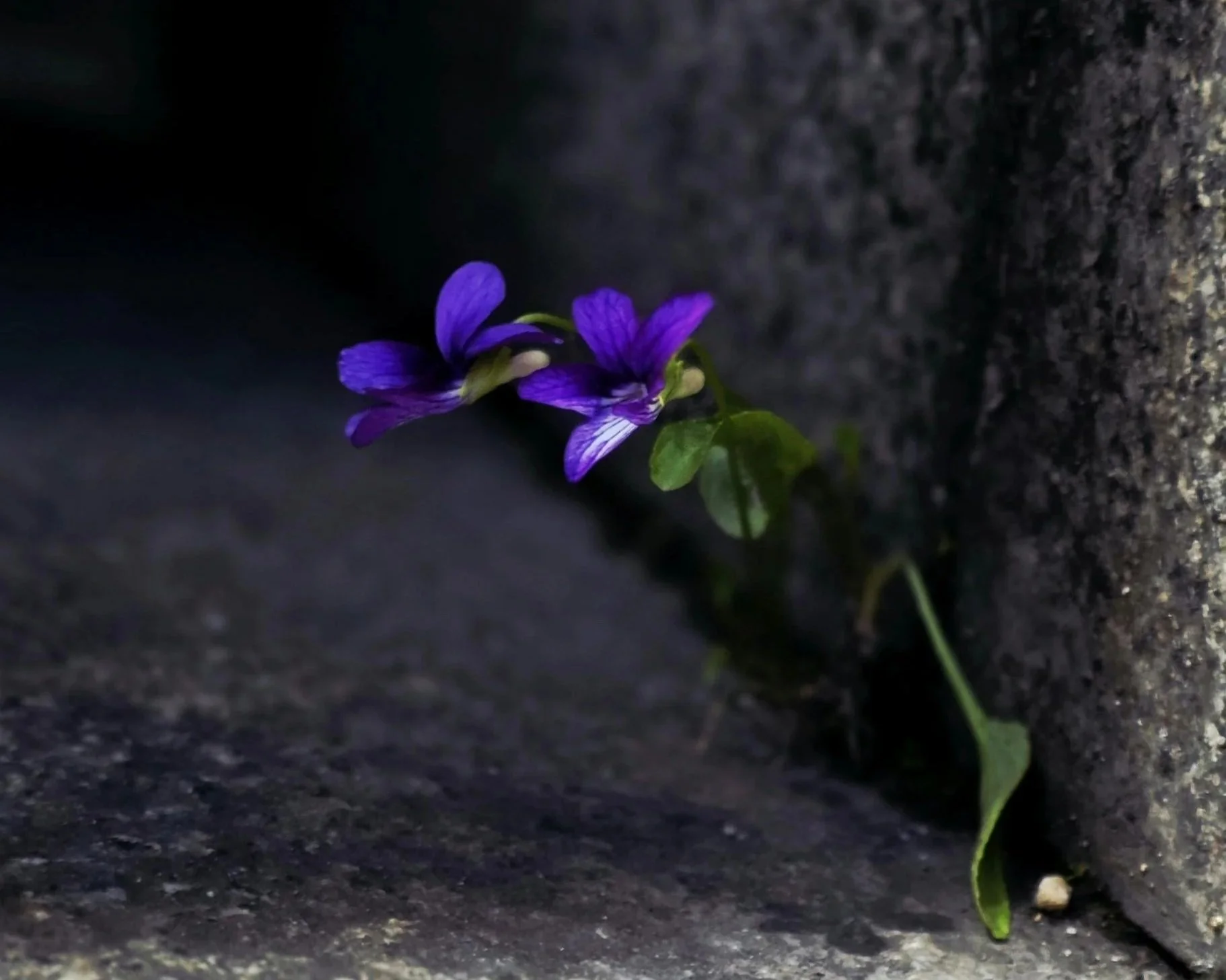
A purple flower growing between concrete cracks. Photo courtesy of Jinhee Lee.
The environment, per se, is diverse: environmental writing can reflect this
EPA: What does your vision for environmental writing look like and what kinds of stories feel necessary or overdue?
TS: It looks inclusive. It looks like someone from the city owning an equal part of the space as well. It also looks like someone writing unapologetically in a non-English language and the reader being the one doing the work, finding a way to understand. It looks like people writing in a way that makes them feel their power and their presence the way they want to show up. The environment, per se, is diverse: environmental writing can reflect this.
EPA: If someone resonates with this discussion or your writing, where would you suggest they start—not just as writers, but as observers of their own environments?
TS: Finding ways to be more self-attuned would be a good start. I often think people find their best writing in states of honesty. It takes a commitment to oneself to be honest. You have to be able to accept where you feel shame, anger, fear, sadness, and happiness, for instance—and know that others won’t always agree with you or “allow” you to feel the ways that you feel; someone somewhere, whether close to you or a stranger, will always try to make you feel like what you’re feeling isn’t right. But good writing happens out of honesty, out of writing with your lens, not someone else’s.
Good writing happens out of honesty, out of writing with your lens, not someone else’s
Closing Thoughts
At its core, You’re Also Eligible is not simply a course on environmental writing. It asks us to reconsider who has historically been granted permission to see themselves as environmental writers—and invites us to see ourselves as environmental writers too.
Through her work, Thammika Songkaeo challenges the inherited mythology surrounding the genre—the idea that meaningful environmental stories must emerge from wilderness, mobility, or distance from urban life. Instead, she asks participants to begin where they are: inside their bodies, neighborhoods, infrastructures, and emotional realities. The course reframes the environment not as a pristine elsewhere, but as the totality of what grounds us daily.
In doing so, Songkaeo opens environmental writing to people who may have previously felt excluded: urban dwellers, people without access to travel, writers working outside English, and anyone whose relationship to place has been nurtured more by the forces of density, labor, migration, or survival than by romanticized ideas of untouched nature.
As our world continues to urbanize and transform, perhaps the future of environmental writing will not be defined by escaping into faraway landscapes, but by a deeper honesty about the landscapes we already inhabit.
This interview has been lightly edited for clarity and flow.
Those interested in Thammika’s course can register their interest via ORP Schools.


Portrait of Thammika Songkaeo. Photo courtesy of Susannah Jaffer.
Thammika Songkaeo is a transnational novelist, nonfiction writer, and film producer of Thai origin, whose lived experiences in India, Uganda, Rwanda, the United States, and Singapore have informed the making of Stamford Hospital, her debut novel following a nomination to the Bread Loaf Environmental Writers Conference, which she attended on a Katharine Bakeless Nason Scholarship, a fellowship to the Comparative Literature PhD programme of the University of Texas at Austin, and a grant from the Smithsonian FreerSackler Galleries. She earned the highest honours for her study of French Literature at Williams College and an MFA in Creative Nonfiction from the Vermont College of Fine Arts before becoming a Storytelling grantee of the National Geographic Society in 2022 and continuing a transnational gaze on stories of the relationship between womanhood and society. Her writing, including a feature of monologues, has appeared in Ninth Letter and in World Literature Today online, and for the Singapore National Library Board. When not writing, she can be found working on social and environmental issues through her company, Two Glasses LLP, designing experiences that transform how people think and feel about their identity and planetary mayhem.
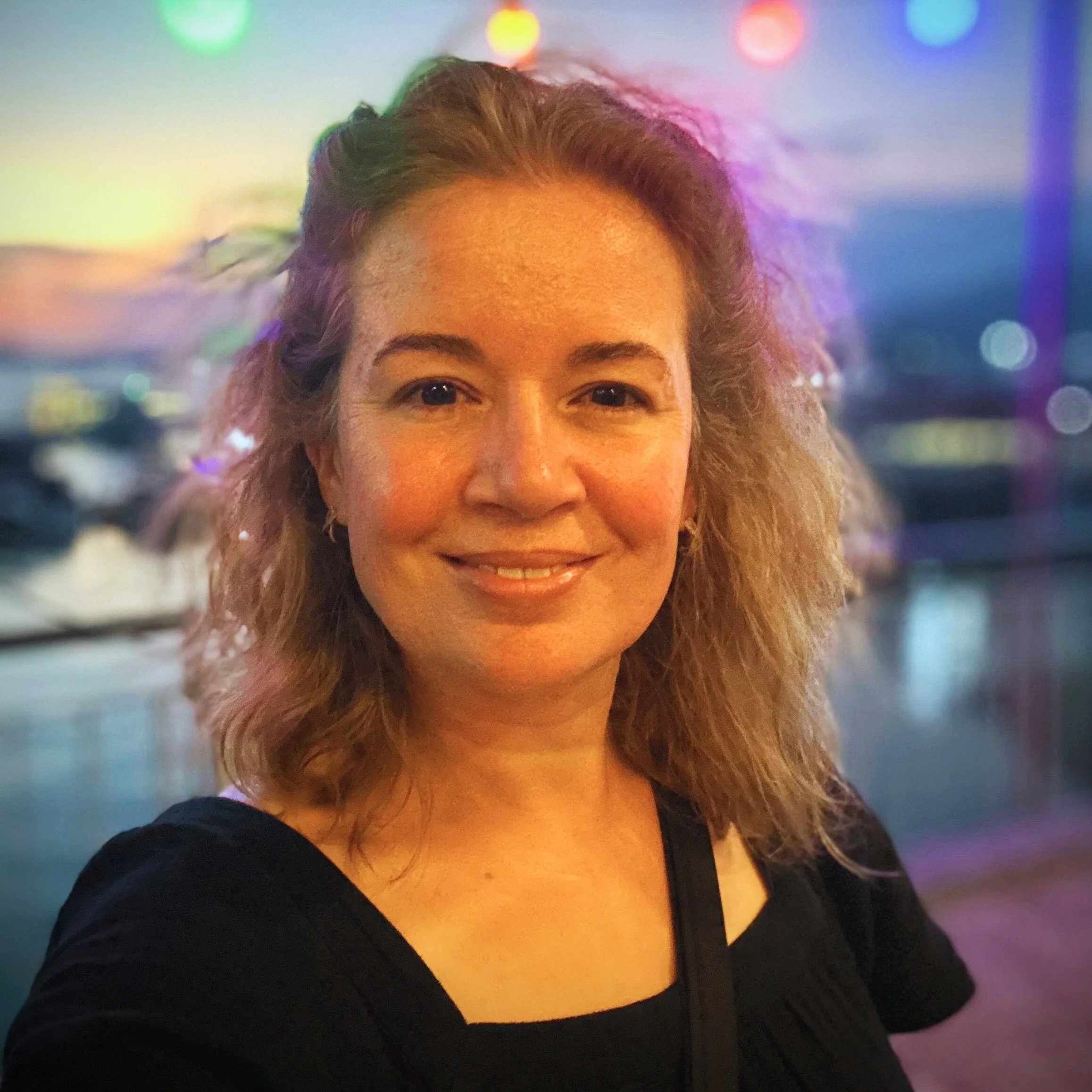
Portrait of Eneida P. Alcalde. Photo courtesy of Eneida P. Alcalde.
Eneida P. Alcalde immigrated to the United States as a child, transplanting her Chilean-Puerto Rican roots into Pennsylvanian soil. A Pushcart Prize-nominated writer and finalist for The Robert Phillips Chapbook Prize, Eneida graduated with an MA in Creative Writing & Literature from Harvard University’s Extension School. She is the poetry editor for Oyster River Pages and a reader for Epiphany Magazine. A past fellow at the Macondo Writers Workshop, her poetry and hybrid work have been featured in several literary outlets, including The Best American Poetry series. Eneida draws inspiration for her writing from her migrant family and ancestors, her young daughter, and the places she has called home—from Valparaíso and Cochabamba to Washington, DC, and Singapore.
Her debut poetry chapbook, The Wealth We Surrendered, is published by Ethel.
Learn more at www.eneidaescribe.com and follow her on Instagram @eneidaescribe.