You’re Also Eligible: Reimagining the Environmental Writer

Portrait of Thammika Songkaeo. Photo courtesy of Susannah Jaffer.
Online through Google Meet
Session 1: Sunday, September 13
Session 2: Sunday, September 20
8:30–10:00 am EDT
$200 — Limited slots available
Course registration closes September 1
The places we call home need our stories.
In this two-part online course, National Geographic Explorer and Penguin Random House author Thammika Songkaeo interrogates the mental barriers we face when shaping stories about ‘the environment’ from our own homes.
Challenging the notion that environmental writing must follow a set template, this course asks: How have we been conditioned to view nature through a pre-packaged lens? What inherited assumptions are we unknowingly recycling, and how can we become engaged environmental writers from anywhere in the world? By challenging biased perspectives, we can learn to write genuinely about our environment as it undergoes a radical transformation—reflecting our true relationship with our ecosystem, no matter where we live.
Course participants will learn how to:
Identify environmental stories in our everyday surroundings, whether in a city, small town, or any other community.
Rethink traditional ideas about environmental writing.
Develop a more personal approach to writing about place.
Experiment with new ways of connecting identity, place, and environmental change.
This course is open to emerging and experienced writers alike. You do not need a background in environmental writing—just bring your curiosity, close attention, and a willingness to engage with new ideas.
A few partial scholarships are available for this course to support writers who need financial assistance. Please email us at schools@oysterriverpages.com if you would like to be considered for a scholarship before submitting this form. Scholarships are limited and awarded on a first-come, first-served basis.

National Geographic Explorer and Penguin Random House Author Thammika Songkaeo interrogates the mental barriers we face when shaping stories about ‘the environment’ from our own homes.
Challenging the notion that environmental writing must follow a set template, this 2-part course asks: How have we been conditioned to view nature through a pre-packaged lens? What inherited assumptions are we unknowingly recycling, and how can we become engaged environmental writers from anywhere in the world? By challenging biased perspectives, we can learn to write genuinely about our environment as it undergoes a radical transformation—reflecting our true relationship with our ecosystem, no matter where we live in the world.
About Thammika Songkaeo
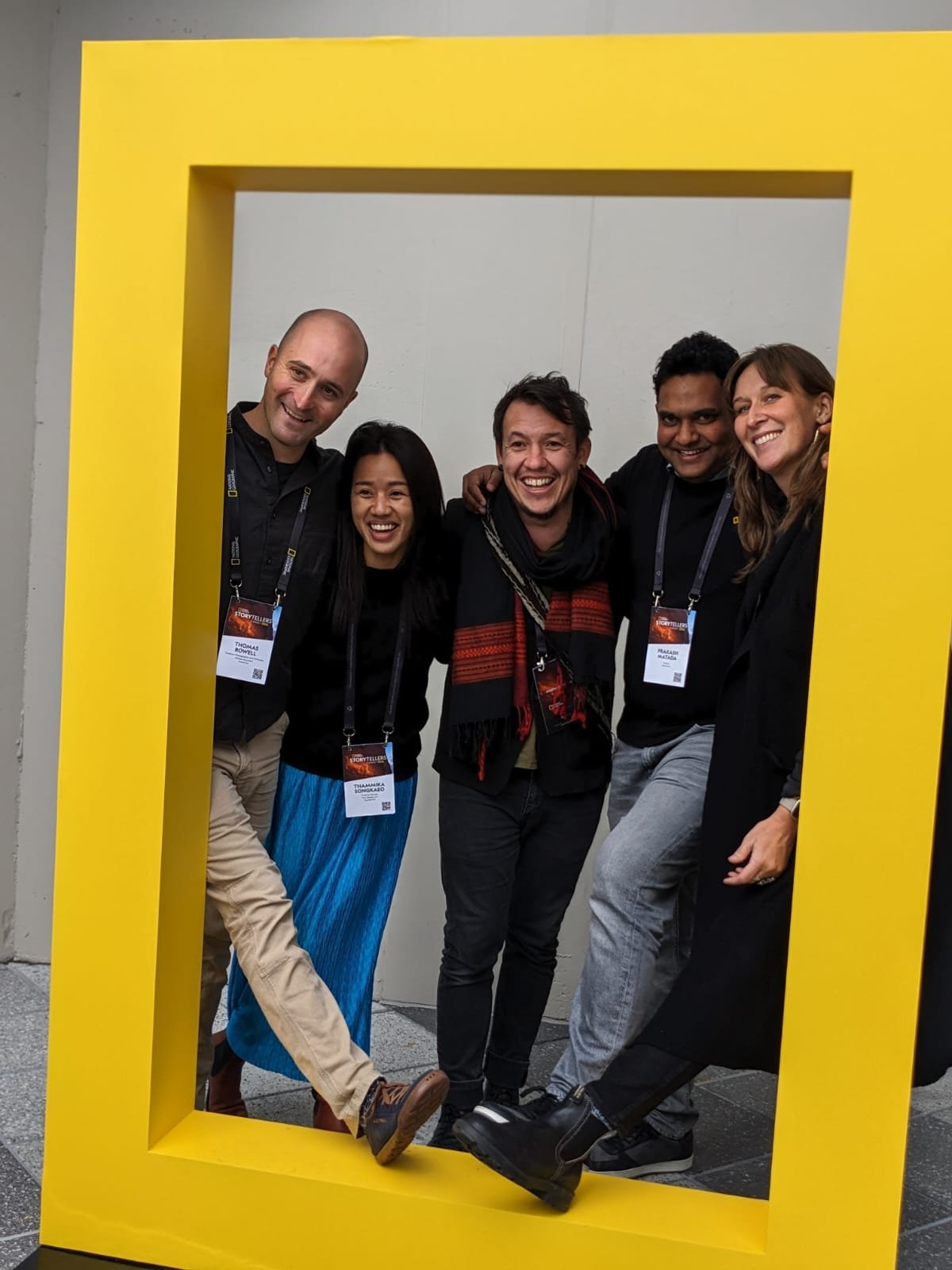
Thammika Songkaeo with fellow National Geographic Explorers, pictured within the iconic National Geographic gold frame. Photo courtesy of Thammika Songkaeo.
Thammika Songkaeo is a transnationalist novelist, nonfiction writer, and film producer of Thai origin whose lived experiences in India, Uganda, Rwanda, the United States, and Singapore informed the creation of Stamford Hospital, her debut novel. The novel was named a must-read for International Women's Day 2025 alongside The Handmaid's Tale and The Second Sex.
When not writing, Thammika works on social and environmental issues through her company, Two Glasses LLP, designing experiences that transform how people think and feel about identity and planetary mayhem. She is the producer of Changing Room, a dance film that asks, "What does criticizing our bodies have to do with climate change?" as well as its global experiential screenings, which incorporate somatic practices and guided journaling. Her social science work has been referenced by the Brookings Institution and The Journal of Southeast Asian Human Rights.
-
Thammika attended the Bread Loaf Environmental Writers' Conference on a Katharine Bakeless Nason Scholarship. She also received a fellowship to the Comparative Literature PhD program at The University of Texas at Austin, which she left after completing the MA to pursue an M.S.Ed. in Higher Education at the University of Pennsylvania, as well as a grant from the Smithsonian Freer|Sackler Galleries. She graduated with Highest Honors in French Literature from Williams College and earned an MFA in Creative Nonfiction from the Vermont College of Fine Arts before becoming a Storytelling grantee of the National Geographic Society in 2022 (also known as a "National Geographic Explorer"). She continues to bring a transnational perspective to stories exploring the relationship between womanhood and society. Her writing, including a feature of monologues, has appeared in Ninth Letter, World Literature Today (online), and publications for the Singapore National Library Board.
Meet Your Instructor
Watch Thammika share what students can expect from her course in this series of videos:
We also invite you to read her interview in Soundings for greater insight into her work and the ideas that inform her teaching and writing.
Frequently Asked Questions
-
This course is open to emerging and experienced writers interested in exploring new ways of thinking about environmental writing. Whether you are a creative nonfiction writer, essayist, journalist, poet, fiction writer, or simply someone interested in reflecting on your everyday experiences, you will have the opportunity to think differently about place and the stories we tell about the world around us. No established environmental writing practice is required.
-
No.
This course challenges the idea that there is only one set way to be an environmental writer.
Many writers do not identify as environmental writers because they believe the field belongs to people writing about wilderness, conservation, or climate science. This course invites you to reconsider this assumption and explore how your own unique experiences and perspective are a valuable—and necessary—part of environmental storytelling.
Otherwise, who will write the stories about the places we call home?
-
No. Environmental writing is not confined to remote landscapes or traditional nature writing.
The environments we inhabit day to day—our homes, our neighborhoods, our cities, our communities, our food systems, our memories, and our relationships—all hold stories worthy of exploration and sharing.
-
Through guided discussion, reflection, and writing practice, participants will grapple with how environmental writing has been shaped by inherited assumptions while discovering fresh and personalized ways of approaching environmental storytelling.
Participants will:
• Identify environmental stories within their everyday surroundings.
• Rethink traditional ideas about what environmental writing can be.
• Develop a more personal approach to writing about place.
• Experiment with new ways of connecting identity, place, and environmental change. -
In the first session, participants will learn to reconnect with their surroundings by using their senses to evaluate their environment—urban or rural—and determine whether their mental and physical needs are being met within that space. Through targeted exercises, they will use these sensory details to craft a rich setting for their writing and bring a protagonist, based on their own sensorial experiences, into the scene. They will leave the session with writing that brings a protagonist and a setting to life together, both as characters that impact one another, however large or small.
In the second session, writers will zoom in on a single element of that setting to examine how environmental change affects the protagonist’s body on a subconscious level. Through a more targeted exercise, they will explore human desires, internal and external conflicts, and the tensions that arise when no environment can perfectly fulfill a protagonist’s needs.
The exercises will lead to writing that answers: Where does tension land in the protagonist’s body, and who do their emotions reach out to—subconsciously and deeply—when they want to ask for change?
The answer may be surprising and revealing, offering insight into the hope or hopelessness our characters feel within their environments.
-
Yes. In both sessions, participants will have the opportunity to share their writing from the exercises during class and receive feedback.
-
The course is live.
-
The course will take place online through Google Meet.
-
Yes. A limited number of partial scholarships are available for writers who need financial assistance. To be considered, please email schools@oysterriverpages.com. Scholarships are awarded on a first-come, first-served basis. That is, those who register first will receive the scholarship.
-
Please email your question to schools@oysterriverpages.com and a member of our team will get back to you as soon as possible.
National Geographic Explorer and Penguin Random House Author Thammika Songkaeo interrogates the mental barriers we face when shaping stories about ‘the environment’ from our own homes.
Challenging the notion that environmental writing must follow a set template, this 2-part course asks: How have we been conditioned to view nature through a pre-packaged lens? What inherited assumptions are we unknowingly recycling, and how can we become engaged environmental writers from anywhere in the world? By challenging biased perspectives, we can learn to write genuinely about our environment as it undergoes a radical transformation—reflecting our true relationship with our ecosystem, no matter where we live in the world.
Not ready to register yet? Sign up to receive a reminder email before registration closes.