Asphalt Is Not Second Nature
Jeffrey-Michael Kane
Geographers call it second nature: the built world, the humanized landscape, the earth as we have remade it in the image of our requirements. The interstate is five percent bitumen and ninety-five percent aggregate — crushed stone, gravel, sand — bound together by the heaviest fraction of petroleum refining, the residue that remains when everything lighter has been driven off by heat. Bitumen is not refined so much as reduced. It is what remains when the useful fractions have been pillaged. The asphalt surface of a highway is, in this precise sense, a waste product: a dense, low- albedo lithic plate, heated by its own chemistry to temperatures twenty to forty degrees Celsius above the surrounding air, absorbing ninety-five percent of incident solar radiation and returning almost none of it to the sky.
The soil it replaced reflected more. Cooled itself through evapotranspiration. Held water at a coefficient of 0.05 to 0.20 — meaning that for every inch of rain, four to twenty percent became runoff and the rest infiltrated, recharged the aquifer, moved slowly through the root zone toward the stream. The highway's runoff coefficient is 0.95. For every inch of rain, ninety-five percent moves immediately across the surface, gathering velocity and chemistry as it goes, and enters the drainage system within minutes of falling.
There are 48,000 miles of Interstate Highway in the United States. There are 4.1 million miles of public road. An estimated thirty to forty percent of the interstate system runs through or adjacent to the 100-year floodplain, because river valleys offered the flat topography that high-speed logistics requires. The highway followed the river. Then the highway replaced it.

A river does several things simultaneously that appear unrelated but are not. It moves water, obviously. But it also moves sediment — capturing it in the floodplain during high water and releasing it slowly, building the alluvial soil that agriculture requires. It recharges groundwater, the water table rising
and falling with the seasonal pulse of snowmelt and rain. It moderates temperature, the riparian corridor ten degrees cooler in summer than the surrounding upland, the cold water descending to the gravel beds where certain fish require specific thermal conditions to complete their reproductive
cycle. It filters. It attenuates. It delays.
The highway does none of these things. It moves water as fast as possible away from the driving surface and into the pipe system, which moves it as fast as possible toward the nearest watercourse. The median is the highway's floodplain: a basin designed not to hold water but to evacuate it, stripped of the sediment-trapping root systems and nutrient-cycling microbiology that make a true floodplain function. The culvert is the highway's tributary: a compressed concrete tube that accepts the drainage of a watershed and delivers it, concentrated and accelerated, to whatever
remains of the original stream.
What remains of the original stream is often not much. The flat land of the river valley has been developed. The wetlands have been filled. The riparian corridor has been narrowed to a strip, then a thread, then a concrete-lined channel moving water away from property. In its place: the highway's own riparian corridor, its own distinctive ecology, its own flora adapted to the specific conditions of impervious surface, thermal mass, road salt, and the chemical byproducts of high-speed rubber friction.

Phragmites australis — the common reed — colonizes the drainage ditches in dense monocultures, thriving in the salt-heavy disturbed soils that nothing else will tolerate. Ailanthus altissima, the tree of heaven, specializes in poor soil and high heat, establishing itself in the canyon walls of overpasses where no maintenance crew can reach it, its roots finding the crack in the concrete where water pools and nutrients concentrate. Kochia scoparia has adapted to the high-sulfur, high-zinc chemistry of the highway shoulder, a chemistry hostile to most vegetation but to which this species has found a metabolic response.
Along the thermal corridor of the highway itself — the strip of anomalous heat generated by the road surface and the engine exhaust and the friction of eleven billion tons of annual freight moving at highway speed — certain ground beetles of the family Carabidae have been documented migrating northward faster than climate models would predict. They are using the highway's heat as a transport corridor, moving through a thermal environment that did not exist before the road, colonizing ranges that their physiology was not equipped to reach unaided. The highway is not merely replacing the riparian ecosystem. It is generating a new one, with its own logic, its own species assemblages, its own migratory patterns — all of them organized around the specific conditions of petroleum-based infrastructure rather than the conditions of water and soil and seasonal light that organized everything before.
6PPD is N-(1,3-dimethylbutyl)-N'-phenyl-p-phenylenediamine. It is added to tire rubber to prevent ozone cracking — the surface degradation that occurs when the double bonds in vulcanized rubber react with atmospheric ozone and the rubber begins to check and craze. Without 6PPD, a tire at highway speed in an ozone-bearing atmosphere would fail within months. With it, the tire lasts for years.
As the tire wears against the road surface, it deposits particulate matter — PM10 and PM2.5, particles ten microns and 2.5 microns in diameter respectively — into the highway environment. This particulate contains 6PPD. When 6PPD reaches the road surface and contacts ozone, it undergoes a transformation: it becomes 6PPD-quinone, C18H22N2O2, a molecule that did not exist in any watershed on earth before the invention of the automobile tire.
The lethal concentration of 6PPD-quinone for Coho salmon — Oncorhynchus kisutch — is 0.8 micrograms per liter. This is the LC50: the concentration at which fifty percent of the population dies. It is among the lowest lethal thresholds of any known substance in aquatic toxicology. The mechanism is called Urban Runoff Mortality Syndrome. Coho entering urban streams during the first autumn rains exhibit gasping, disorientation, loss of equilibrium. They die within hours. They die before they can spawn.
The first autumn rain is the critical event. After a dry summer, 6PPD-quinone has accumulated on highway surfaces across the watershed — in the tire dust on the asphalt, in the particulate settled into the drainage grates, in the chemical film on the gutters and culverts. The first rain mobilizes all of it simultaneously. This is the first flush: the concentrated pulse of accumulated chemistry that moves through the synthetic tributary system and enters the stream in a bolus, a chemical wave that arrives precisely when the Coho have returned from the ocean to complete their reproductive cycle in the gravel beds where they were born.
The highway does not intend this. It has no intentions. It is five percent bitumen and ninety-five percent aggregate, absorbing heat, generating chemistry, moving freight. The coho are in the wrong watershed at the wrong time, entering a stream that has been chemically altered by a molecule that did not exist when the species evolved its migratory pattern. The highway did not replace the river. The highway became the river — the primary hydrological event in the watershed, the thing that determines what flows where and when and carrying what — and the coho cannot tell the difference until it is too late to turn around.
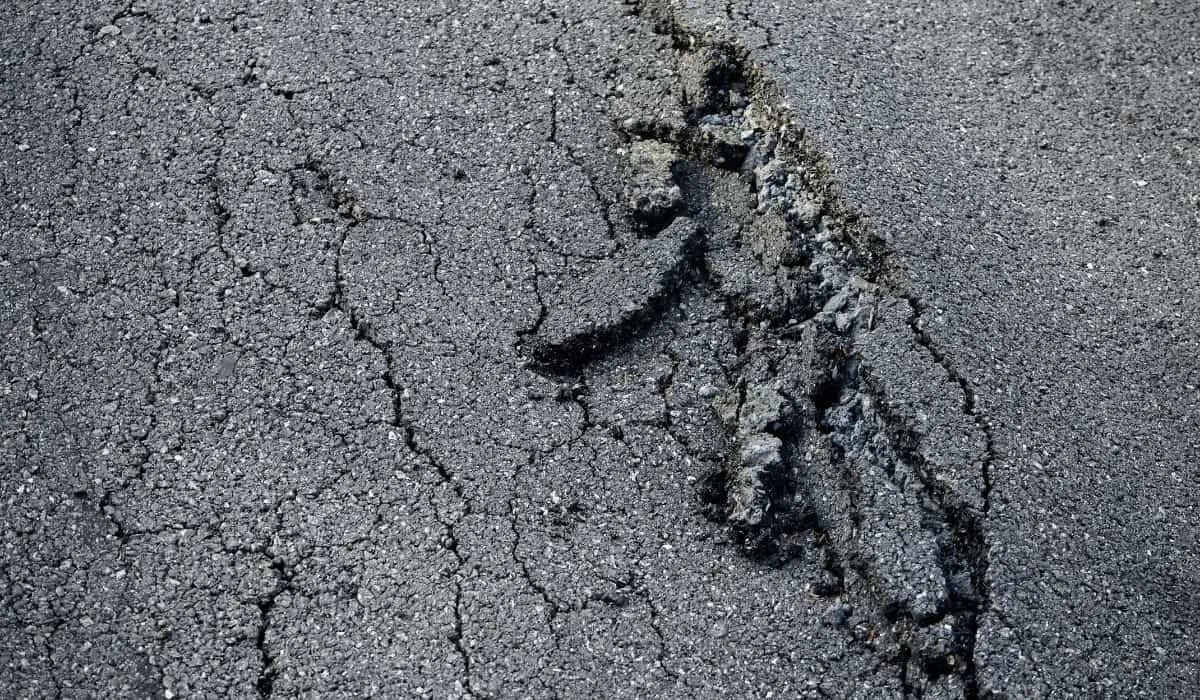
The asphalt surface lasts fifteen to twenty years before major rehabilitation is required. As it ages, it develops alligator cracking — a network of fractures across the surface that resembles, in aerial photographs, the dried bed of a lake. Water enters the sub-base. The compressed geology of the highway begins to fail. Frost heaves push upward. Potholes open.
In the cracks, Taraxacum — the dandelion — establishes itself, its taproot following the fracture line downward toward the sub-base moisture. Digitaria colonizes the shoulder where the aggregate has been displaced and bare soil is briefly exposed. The succession is not toward the original plant community — toward the riparian vegetation that once held the floodplain soil and shaded the stream and fed the insects that fed the fish. It is toward the disturbance specialists, the gap colonizers, the species adapted to the specific conditions of petroleum chemistry and compacted sub-base and the intermittent hydrology of pavement failure.
The river is not a river anymore. It is a drainage calculation, a runoff coefficient, a first flush event, a lethal pulse of accumulated chemistry moving through a concrete pipe toward a gravel bed where a fish is waiting for conditions that no longer exist.
The highway moved eleven billion tons of freight last year. The Coho moved nothing. They are in the gravel, turning in slow circles, losing equilibrium, losing the thread of the current, unable to complete the only migration that matters.
Asphalt is not second nature. It is a third thing — one that moves freight without intention, generates chemistry as a consequence, and assumes the hydrological role of what it replaced without any of the functions that made the original viable.