
Ambiguous Horizons: A Review of Kim Fu’s “Lesser Known Monsters of the 21st Century”
Lena King
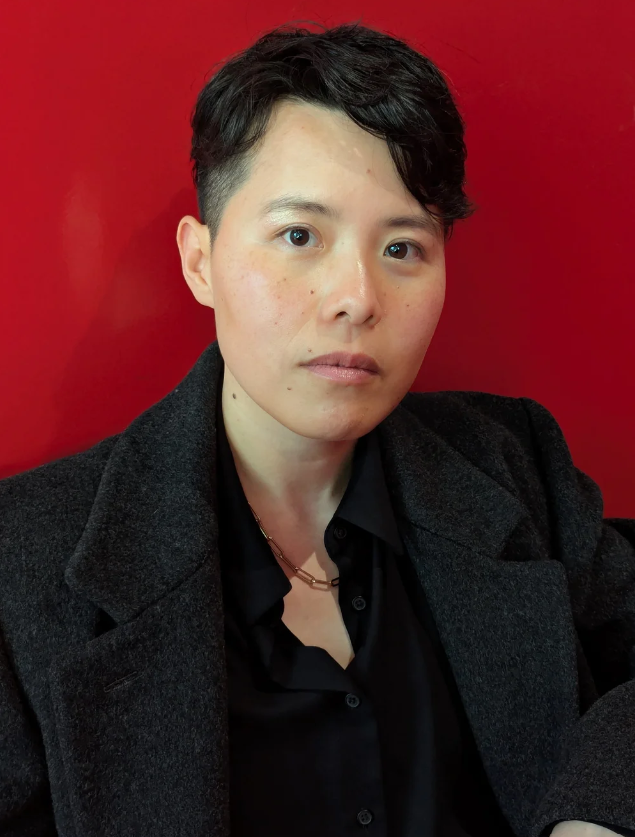
Kim Fu
“Lesser Known Monsters of the 21st Century”, by Kim Fu is a collection of short stories that at no point shies away from the difficult and complex questions that have plagued humans from the beginning. Think grief. Think connection. Think love. Think lust. But what makes this book sting is the way these emotions and quandaries come up against the technology that is shaping the experience of being alive in the 21st century. Kim Fu writes in an unsentimental voice, and uses precise and incisive language that allows the reader space for their own feelings. The immediacy of the lines is gripping:
“She knew the pinprick-sized location—above the stem of my spine, behind the Cupid’s bow of my upper lip, in the center of my brain—where my soul resided, and took it out with a perfect bull’s-eye shot.”
This aptly summarizes the experience of reading the book.

The opening story, “Pre-Simulation Consultation XF007867”, is a transcribed conversation between a client and the operator of a futuristic simulation where virtual reality can simulate anything for the client. The story explores the addictive power of living for a couple of hours in a reality where lost loved ones can be recovered. The client and the operator argue about the ethics of allowing people to live briefly in a fantasy where there is no sorrow, and whether or not it is exploitative to enable that to which human beings are so vulnerable. Who wouldn’t want to return to a time where their loved one isn’t gone? It’s extremely tempting to try and live a version of life where the pain can be removed. The story explores what responsibility people have to one another when someone is experiencing intense, and in some cases debilitating, grief.
“But if we – if we advertise that someone can see their dead child again, they can see their village before the war, they can have a version of their life where their family is intact, go back to before it was shattered, they can live one ordinary day without grief…And if they choose to live inside of that fantasy, if they choose to forsake the real world and all its’ sorrows—then we’re the bad guys.”
“Time Cubes” is another speculative story that explores the possibilities of speeding through life— and what would or would not be missed. “Time Cubes” is carried along by the momentum generated by two key elements. First, there is the existence of the time cube, detailed by Fu extremely realistically, where the flick of a switch sends a plant from seed to bloom to death in the span of seconds. The second element is the protagonist, who is identified as a “depressive”. The resulting story gently meditates on what having the power to control life’s speed would mean in the hands of different people. In the hands of the salesman the time cube is a gimmick, being sold at a kiosk in the mall to impressionable children. The climax of the story lies in what the “depressive” will do with it. The ubiquity of depressed peoples in the story is a nod to the millennial ennui and there is a sad beauty in the way that someone who is depressed and experiences feelings of loss of agency, through a time cube, can gain a sense of control.
“20 Hours” dances along a line of speculative ideas in a similar way to “Time Cubes”. The story looks at what a relationship would look like between a husband and wife if they each were able to murder the other with the promise that each would be reborn in twenty hours. The story explores the cyclical ways that people in relationships push each other away, yearn for each other, and are relieved at their return. The difficult moments of marriage and intimate life are brought to light with great clarity in a world where temporarily killing the spouse is an option that allows for a cathartic release. Readers should be prepared to be left gutted by the end.
In “#Climbing Nation”, Fu delves into the ambiguity of the one-way relationships formed by viewers and content creators on social media. It is a chilling tale of bearing witness, set at a funeral populated only by young people. The lack of parents, or extended family/community gives the whole thing a feeling of existing separately from reality. The story is haunting, lonely, and addresses how much can be faked based by the forms projected out into the internet.
In “The Sandman” the book moves away from directly questioning the power of technology and its power into a mystical realm. The main character is missing sleep and love at different moments, and through the unspooling thread of the story the reader is taken along for the journey of what the lack of both can do to a person. The mundane every day and clear way with which the sleeplessness is rendered contrasts excitingly with the mysterious and other worldly appearances of the Sandman. The story is composed of two spaces- the logic bound day-to-day experience of the sleep deprived main character, who haunts her office like a zombie, and the mysterious realm of the night, replete with unexpected visits from the Sandman. There is a sensuality to the dark parts of the story that contrasts with the light parts, which have an arid quality. By the end the two merge quietly into one. Don’t be fooled by the seamless way the prose and plot ties together. This story sticks, in a way that only those who are asleep can know, and those who are awake can never say.
Similar ideas of vanishing certainty are explored in “In this Fantasy”, a vignette style period piece out of the 1800’s, time stamped by antiquated views of single women. There are echoes of ideas like those in Carmen Maria Machado’s “Inventory”, of horizon lines that continue to get farther and farther away. The language continues to be beautiful:
“My head on a pike for this sweet, short, pleasure drenched life?”
The story “Liddy, First to Fly” explores the horizon line that is coming of age, as well as the nature of friendship. Four young female protagonists discover that one of them, Liddy, has sprouted wings. The girls experience the emergence of Liddy’s wings on the playground, a place where they sneak moments of privacy and freedom from the watchful eyes of the adults in their lives. A boy that runs by and makes fun of them, inadvertently popping their magical bubble realistically illustrates how precarious and fleeting these moments really are. Fu deftly combines this enchanted event with plain and grounding details that bring the reader into the scenes. There is a great sense of this balance throughout the collection that makes “Lesser Known Monsters of the 21st Century” very engaging. Fu also cleverly addresses the doubts that the reader might have about the feasibility of these wings, through the character of Grace, who assesses the science and physics of the wings. A conversation takes place between Liddy and her friend Mags that goes like this:
“Are you scared?” Mags asked. After a beat Liddy replied, “No. It’s weird. It’s like there’s a part of my brain that knows I should be, but I just don’t feel it.”
This is a mirror for what the experience of reading the story holds as well. There is reason to fear the implications of a young girl being given wings with no explanation. But the excitement and potential of the girls is too potent in the story for fear to dominate.
Just like in “Liddy , First to Fly”, children in “The Doll” are rendered with great insight and clarity:
“I was one kind of ghoul: a boy to whom nothing bad had happened, all suffering as unreal as comic book gore. Connor was another: a child to whom many bad things had happened, who relished any story where he was not the victim.”
The children in “The Doll” are trying to understand death. Through their eyes Fu offers a very transparent lens with which to address the incredible gravity of losing people, there one day and gone the next. It is an experience that with age perhaps gets easier to accept, but not to understand. Accessing these questions through a child is an accessible angle with which to tackle a topic that is ultimately insurmountable, while managing the economy of words which is required by the short story form. “The Doll” also addresses the theme of how memories stay with people, follow them, and in some ways, never really leave. This story subtly and delicately renders what being haunted looks and feels like. There are no consequences or stakes, just a presence that ebbs and flows in clarity, ever-present on the periphery.
The collection is admirably diverse in the subject matter that the stories address. There are many highly realized settings and none perhaps more so than the theater stage upon which “Scissors” plays out. There is immediate tension in the character Dee’s restraints, the stage, the audience, and the vulnerability of Dee’s soft body as scissor blades press into her skin. Fu’s precise language can be felt in the bodily sensations of the story as it explores themes of trust and vulnerability, loss of agency, and the sharp truth that in the presence of another person we are never completely in control. The story is reminiscent of Kafka’s “The Hunger Artist” in its examination of the mob mentality, and the mentality of the performer(s) in the face of a crowd, and was also featured in the collection Kink, and may not be safe for work!
Of all the stories in the collection “June Bugs” is the most traditional nod to the genre of short story. A Raymond Carver-like bleak and lonely domesticity combines with the eerie vulnerability of a woman alone in her home that Joyce Carol Oates captures so chillingly. “June Bugs” is a gripping tale of fear and freedom. The hyper realistic presence of the June Bugs beats intensely against the protagonist and in turn the reader. The metaphor of the bugs is skillfully shifted around the story, sometimes symbolic of pervasive anxiety, other times of PTSD, and other times of the inner power that the woman possesses. Fu’s icy prose is unflinching in its depiction of a woman’s journey away from abuse, and all the difficulties along that road, both internal and external.
“Bridezilla” unfurls in a spirit of self-actualization in a much more bizarre and satisfyingly mysterious way. The bride’s consciousness dissolves and becomes one with the natural world’s and in the moment she is liberated from doing the right thing and from being a good or a bad person. She is able to step off the linear conveyor belt, and simply put one foot in front of the other. Elements which will not be spoiled include a sea monster, a dog, and the smiling face of a sailor aboard a ship! What is included and what is omitted is especially important in this story.
The collection closes with “Do You Remember Candy”, which rings of life in the age of the Covid-19 pandemic. The driving element is a loss of taste, and just like in “The Sandman”, there is a fluid movement from the real to unreal. Fu has a deft sense of control as the writing switches between grounded plot points, and thought-provoking speculation about the people living through the unprecedented times of the ongoing covid-19 pandemic:
“The sensuous, life-affirming pleasure upon which whole cultures were built, which caused empires to rise and fall, will die with Allie and her peers.”
“Do You Remember Candy” raises questions of what the effects of all that has been lost in the pandemic will do to a generation of people.
The questions begged in the spare and luminous collection of stories that make up “Lesser Known Monsters of the 21st Century”, do not yield easy answers.
“Who can sleep in these worrying times?”
Who indeed can sleep while our paradigms seem to be changing at an unfathomable clip? Fu’s characters, placed in realities just beyond ours, give voice and shape to what keeps us up at night: how can we have intimacy in a world that has been destabilized by technology created by people who don’t know how to control it? The book allows us, the reader, to inspect closely, if we dare, these Lesser Known Monsters of the 21st Century.