I.S. Jones’s Bloodmercy (Review)
Beth brown preston
This debut collection of poetry, Bloodmercy, by Nigerian/American Itiola S. Jones is a reimagining and retelling of the biblical story of Adam and Eve. In the original narrative from the Bible, Adam and Eve, the first humans, are living a life of paradise in the Garden of Eden. They are forbidden to eat fruit from the tree of good and evil. A serpent tempts Eve to eat the fruit from the tree of knowledge, and they are expelled from the Garden. God inflicts punishment upon them. For Eve, her punishment means that she will suffer the pain of childbirth and live in obeisance to her husband. Together, Adam and Eve bear many children, including Cain and Abel. In the Bible, Cain kills Abel out of jealousy when God prefers Abel's offering to his, thus becoming the first murderer.
"Violence is a failure of communication" is the opening line of this collection. Cain and Abel are reimagined as sisters whose love for each other becomes fraught with jealousy as they both compete for the attention of their negligent father. Cain does not kill Abel. Instead, the girls' bodies blossom as they experience the shame of their mother Eve's sin, while also coming into their own budding sexuality. Bloodmercy follows the sisters Cain and Abel as they grow from girlhood to womanhood–becoming women who ultimately discover the limits of power and control, violence and sexuality, faith, death, and mankind's failed attempt to hold dominion over the world.
Bloodmercy was selected by Nicole Sealey as the winner of the 2025 American Poetry Review/Honickman First Book Prize. Jones is the first Black woman to receive this prestigious award. Nicole Sealey remarks in her Introduction to the collection: "...Bloodmercy, asks, from its opening to closing poems: What does mercy look like? Rather than fully formed renderings, Jones offers composite sketches - images mined from the poet's sharp and singular vision. With verse from the perspective of Eve and a thread of poems reimagining Cain and Abel as sisters, Bloodmercy wrestles with the idea of grace vis-à-vis myth and memory, gender and sexuality, with the utmost urgency." (Introduction, Bloodmercy, p.1)
The poems are set in an evolving remote natural landscape, a realm between the Old Testament and the modern era, as the two girls begin to mature, to gaze heavenward, and pose questions to God. The collection begins with a kind of prelude, in Cain's voice: "After the Offering Ritual, Cain Carries Abel Home." In the Bible, it was an offering ritual that caused Cain's jealousy to overcome him and murder Abel. In Jones's poem, Cain does not slay her sister but tries to soothe Abel after they kill a sacrificial goat:
Again, the reader sees: The longest nights can also boast the brightest moons. From “The Story of a Crow” to “Ashes” to “A Strong Seed,” character after character chooses the brave, honorable, and collective-but-not-conformist road, reminding us what it really takes to be good.
We have blood and dirt,
together they make God. And what does mercy look like
between humans? A sister reaching to lift a sister
from the ground. When I say a love that will end us,
I mean 'mercy. Remember, I offered you my hand once.
Push me away if you like.
("After the Offering Ritual...," p. 5)
The poems are all told in the voice of either Cain, Abel, or Eve. However, Bloodmercy focuses on the sisters as they grow into womanhood. "Daddy's Girl," in Cain's voice, begins, "Lord forgive me, I am my father's child: / cunning and arrogant with beauty." She continues her celebration of childhood:
I am 8
and can only see my mother for her gender —
exhausted to a numb, wounded, bitter
to the touch. The feminine urge to be
my father's best boi, I boy'd better the other boys — peed standing up,
won every game of 'nut check,' shot
my first kill by 10...
("Daddy's Girl," p. 15)
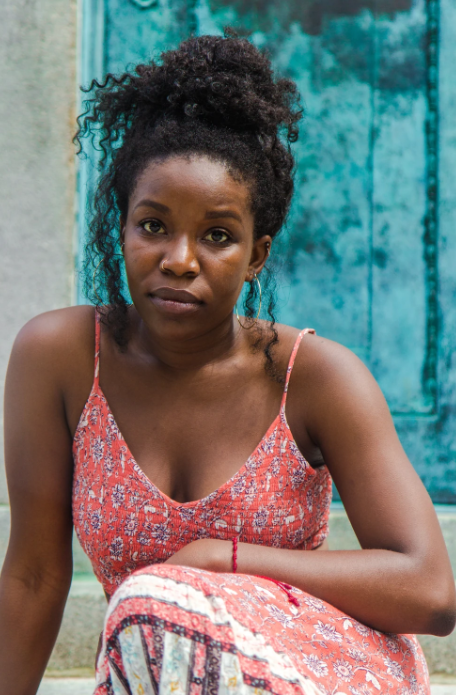
Itiola S. Jones
Jones's poetic lines discomfort and attempt to transform her readers as in the poem "Sister's Keeper": "I peeled back my skin to unveil a body / Baba would find use in." (p. 10) An understanding of the self through wound is a recurrent theme of these poems leaning toward the grotesque. Speaking about her imagination, the poet has said: "There's a delight I have in making language around the things that often bring us discomfort. Discomfort is not something that is a deterrent for me. If anything, the things that make me the most uncomfortable is where the art-making for me begins. I also think about how the grotesque, at least in the context of this book, is a measure of survival." (Summer Farah, Electric Lit Interview - 11/04/2025)
Jones has also revealed that, when she wrote this book, she imagined herself as Cain — creating a myth of her own coming of age and emergence into womanhood. "Blood" to the poet means a bond, a familial connection, a unity, despite dysfunction or absence. These poems explore the meaning of violence, desire, queerness, faith, power and control, and the search for mercy and forgiveness.
I.S. Jones is an American/Nigerian poet and editor. She has received fellowships from Hedgebrook, Callaloo, The Watering Hole, and Brooklyn Poets. She is a senior editor for Poetry Northwest where she runs a column, “The Legacy Suite.” Her chapbook Spells of My Name was published with Newfound in 2021. She is the 2024-2025 Artist-in-Residence at Northwestern University with the Black Arts Consortium.