
What We Get Wrong About the Suburbs: On DTF St. Louis and the Problem of Recognition
Richard Hurst

I grew up in Levittown, Pennsylvania, a third-generation Levittowner. The story I was supposed to inherit about a place like that was already well established. Suburban life, we are told, is defined by quiet desperation: stable but emotionally hollow, full of relationships that function but do not fulfill. The claim has become so familiar that it rarely needs to be defended. Stability itself is taken as evidence of something missing.
The landscape of Levittown never presented itself as dramatic. Low houses, short driveways, incremental additions, shopping centers arranged around parking lots. Nothing in it announced intensity. That may be part of the point.
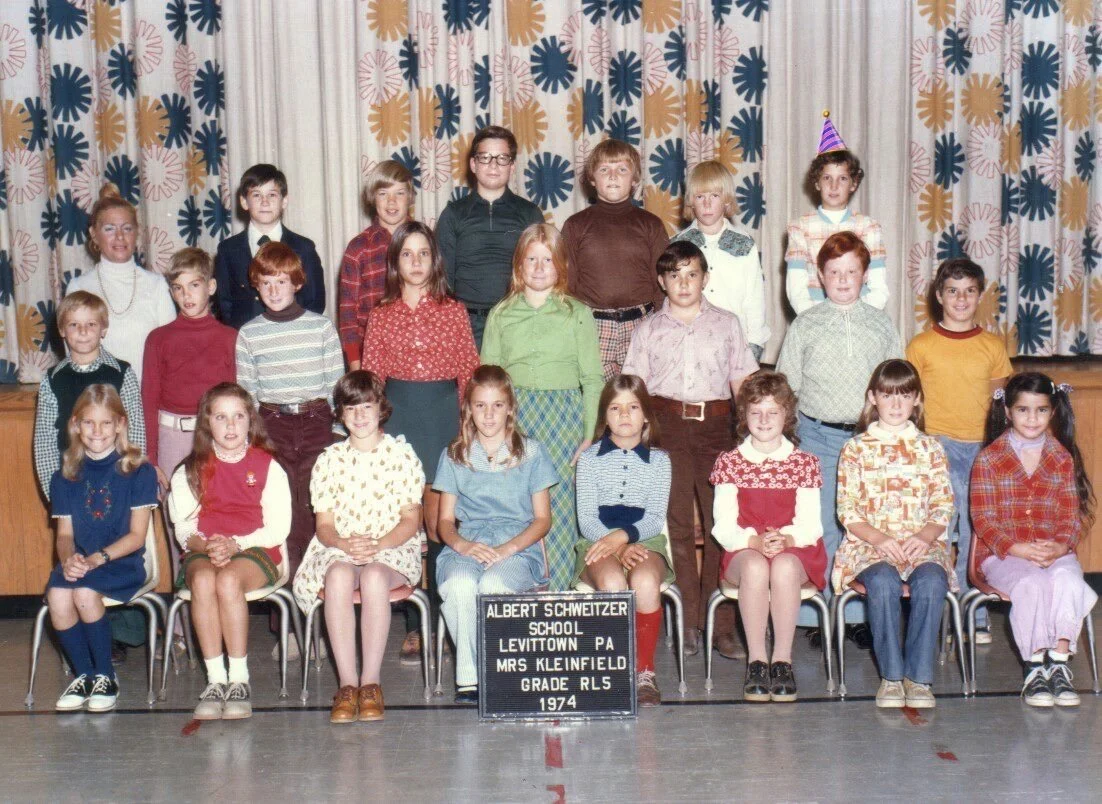
The author’s grade 5 elementary-school class at Albert Schweitzer Elementary School in Levittown, Pennsylvania, circa 1974. Courtesy of Richard Hurst.
Yet the problem may not be that suburban life fails to produce fulfillment. It may be that we have lost the ability to recognize fulfillment when it appears in ordinary form. What looks like emotional insufficiency is sometimes a misrecognized sufficiency. But it is not clear that the distinction can always be drawn with confidence. The expectation that fulfillment must be intense, transformative, or new has altered not only how we interpret lives, but what we are able to experience as meaningful within them.
This expectation now operates less as an argument than as a condition of perception. When a character appears restless within a stable life, the assumption is that something essential must be absent. The narrative task becomes one of uncovering the hidden deficiency that explains the dissatisfaction. Stability demands an explanation because it is no longer understood as a possible form of success.
DTF St. Louis, an HBO Max series created by Steven Conrad, moves within this framework and quietly unsettles it. The series centers on Floyd, an apparently ordinary Midwestern suburban father whose life begins to come apart. He reinvents himself professionally, participates in emotionally intense group therapy sessions, and pursues encounters with men and women arranged through a hook-up app. The familiar reading is readily available: Floyd is restless because his life is empty; his actions are attempts to fill a void.
There is, however, another way to read him, and it cannot be dismissed. It is possible that nothing essential is missing, and also that something in his life has reached its limit. Stability can sustain a life, but it can also define its boundaries. What appears sufficient may also feel final. The question is not only whether his life contains enough, but whether it contains the possibility of becoming something else—and whether those two questions can be separated.

Linda Cardellini as Carol, David Harbour as Floyd, and Jason Bateman as Clark in HBO’s DTF St. Louis.
The series does not resolve this tension. From the outset, Floyd’s marriage is neither loveless nor visibly broken. His relationship with his wife contains recognition, care, and a mutual presence that does not announce itself in dramatic terms. It simply exists without conforming to the expectation that fulfillment must feel extraordinary. What emerges is not the absence of connection but a difficulty in recognizing it. Floyd’s actions do not conclusively expose a life devoid of meaning. They expose the pressure to believe that what he already has cannot count as enough.
This pressure has a broader cultural logic. Narratives from Revolutionary Road to Mad Men and Breaking Bad have reinforced the idea that authenticity requires rupture. Frank and April Wheeler imagine that leaving suburbia for Paris will recover their exceptional selves. Don Draper breaks with his apparently perfect suburban marriage and remakes himself alongside a younger, more spontaneous wife. Walter White abandons the identity of the unremarkable high-school chemistry teacher, ostensibly to provide for his family after his cancer diagnosis, only to discover that the darker life makes him feel capable and alive. These stories ultimately expose the costs and illusions of such transformations, but they first make rupture legible as self-discovery. Within that framework, stability becomes suspect. Rather than asking whether a life is sustaining, we ask whether it is sufficiently dramatic.
This shift changes not only how we evaluate lives but how they are lived from within. If fulfillment must announce itself as intensity or transformation, ordinary forms of life begin to feel insufficient even when they are not. Stability and home life are mistaken for stagnation. Love, even of the most transcendent kind, can be recast as a trap from which we must escape to find ourselves. Commitments to family and neighbors cease to register as civic responsibility and become tired traditions to be traded for solitary experiences in remote places. The series makes this hierarchy visible in Floyd’s response to his wife’s work as a Little League umpire. She excels in the role and is named Umpire of the Year, an honor that surprises her and makes remarkably little impression on her. She scarcely recognizes the effect her service has on the community. Floyd, meanwhile, finds her uniform, the visible emblem of that service, physically repellent. What the community recognizes as civic commitment, he experiences as the deadening familiarity of the life he already knows. The departure counts as transformation; a life quietly made in familiar surroundings does not.

Carol and Arlan (played by Arlan Ruff) in HBO’s DTF St. Louis.
DTF St. Louis stages this inversion without fully endorsing it. Floyd attempts professional reinvention by becoming a sign-language interpreter, indulges his sexual curiosity through encounters with women and men from a dating app, and even encourages his wife’s affair, becoming a literal fly on the wall as he witnesses it. Yet these experiences neither liberate him nor simply return him to the person he was. The series instead reveals something deep and meaningful already close at hand: his friendship with Clark Forrest, the weatherman whose broadcasts he interprets and who becomes his neighbor and friend. The depth of that friendship is made explicit to the viewer even as Floyd judges himself a failure when a far more superficial encounter arranged through the app falls through. What he lacks is not connection but the ability to recognize the relative value of the connections already present in his life. The series presents a life whose meaning remains unsettled and, more tragically, unrecognized by the person living it.
That openness is precisely what the dominant cultural narrative tends to close. Conrad has described the series more simply as a story about middle-aged people making “bad decisions involving sex.” The description is not wrong. It is incomplete. It converts a question about how to read a life into a judgment about how to behave within it. What had been a problem of recognition becomes a problem of conduct.
When confronted with ambiguity, we tend to resolve it by choosing the interpretation that is easiest to sustain. In this case, the easier interpretation is that Floyd’s life must have been lacking something essential. His actions then become evidence of that lack. But the alternative—that the criteria for recognizing fulfillment may themselves be unstable—remains difficult to hold.
The cost of this difficulty is not merely interpretive. When ordinary forms of connection are treated as insufficient, they become difficult to recognize as sources of fulfillment at all. Stability begins to appear as failure. Relationships that quietly sustain a life are judged against standards they cannot satisfy. The result is not greater authenticity, but a growing uncertainty about what fulfillment would even look like if it were present.

A residential street in Levittown, Pennsylvania. Photograph by Carol M. Highsmith, Library of Congress.
What DTF St. Louis reveals is not that suburban life is empty, but that our expectations have made it difficult to say what would count as otherwise. The series does not resolve that difficulty. It preserves it. It allows a form of connection to remain visible without insisting that it justify itself in the terms our culture demands.
That refusal matters. It preserves the possibility that fulfillment may already be present in forms we have learned to overlook. It also preserves the possibility that such fulfillment may not feel sufficient to those who inhabit it. Floyd’s actions do not resolve this tension. They inhabit it. The question of whether his life is enough remains open, not because it cannot be answered, but because the terms in which an answer would make sense are no longer secure.
The suburbs have come to stand in for that uncertainty. They appear empty not because they lack meaning, but because we have forgotten how to recognize it—or have come to doubt that what can be recognized there can be enough.